


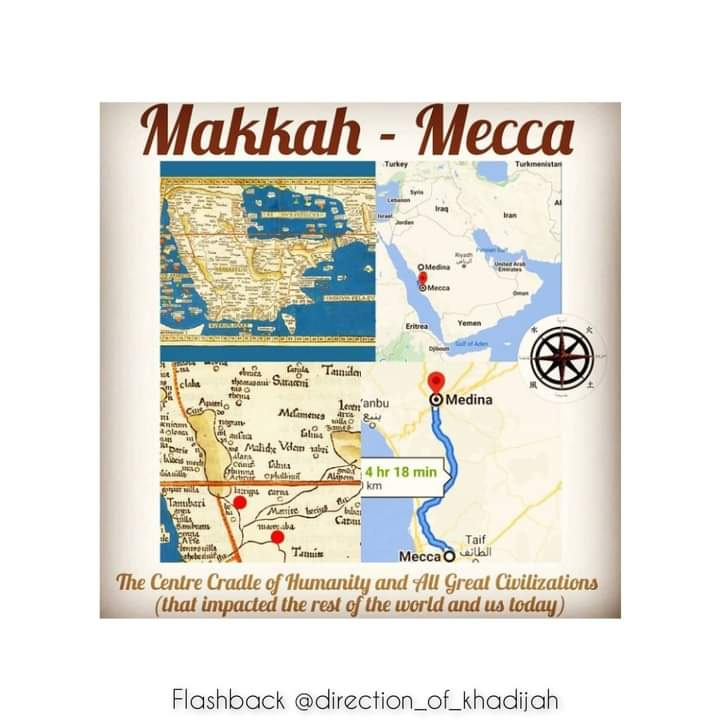
FINDING MECCA ON THE MAP
We exited Babylon with a quick recap on the Sumerian legacy. A people so astronomically advanced that it would take at least a couple of hours to appreciate the minimum of this.
Their Astronomy became astrology…
The origin of their advancement has been found in modern-day Armenia which influenced the Indus Valley and around the Fertile Crescent towards the west.
Ibrahim AS was therefore also very knowledgeable when it came to the stars.
He came from a nation that was very sophisticated when it came to architecture and math.
Again I caught myself in this interview pronouncing the Hittites while linking them to the Akadians who were also connected to Ibrahim’s people - Peace be upon him.
So it's interesting to note how the ‘New World Order’ seems to be so interested in Iraq…
We also looked at the houses in the time of Nabi Ibrahim AS, with mud structures underdeveloped in comparison to the urbanization of Babylon and its towering mansions.
Then at one point, Qaadirah mentions the dream of Nabi Yusuf AS of celestial bodies in prostration. How do round objects bow? Would they not have to be personified to do so? Did Yusuf AS carry the cellular memory of his ancestors' observation of statues depicted as celestial bodies personified? While their ancestor was challenging his father regarding them being worshipped; Yusuf AS goes to his father (a prophet) and tells him that they were bowing to him.
This image teaches us that the heavens have been made subject to man yet mankind has been worshipping the heavens among other things. The universe is subject to us.
The Qu’ran says the heavens were created to serve… and they certainly impacted the Middle World.
This part of the ‘Middle World’ of Ibrahiem AS had city roof gardens and telescopes. They left us with cuneiforms and ruins that, unlike the Indus Valley and Yemen, have been deciphered.
Their ziggurats had stairs going up, attempting to reach the heavens. Was this the inspiration for the pyramids and Firawn’s “stairway to meet the Lord of Musa”?
The ancestor of Musa must have used a sharp axe to smash idols made of hard rock imported.
It makes sense that he went for the smaller ones and blamed the big ones.
These were the same dumb rocks that stood still and watched the priests eat their food…
The known sequence of events leads the three believers to journey around the crescent with Lut AS eventually replaced by Hajjar RA.
Hajjar brings with her a fourth edition to the party leading to a sequence of events where both she and her son are in a desert with no hanging gardens…
A place called Bakkah, otherwise known as Makkah…
According to Psalms and Rabbis, there were highways to Bakkah surrounded by the Byzantine and other empires.
But since it was a desert no one was interested in this place. It reminded me of Khidr breaking the boat preventing it from being stolen…
Now we find oil which contributes to vehicles while back then camels were the focus when it came to transport. Either way, there's a trade theme much like the Cape of Good Hope facilitating travellers sailing around it.
Arabia has been Latinised from ‘arab’ and this area was influenced by ‘Indo-European’ religions with idols coming in with the traders.
In this way, Makkah had become infiltrated by Sumerians via Babylon.
We then looked at examples of how people undermine various religions and cultures. Usually with colonialist intention.
A true scholar doesn't dismiss huge chunks of humanity and appreciates at least objectively different views.
The enemies of Islam don't do that but cherry-pick as it suits them…
There's only Ptolemy’s map besides Arab word of mouth.
It was the desert, Arabs were illiterate and people tended to stay there. Whereas the Fertile Crescent witnessed and documented a lot of travel, typically we don't have the same amount of information about the place whose meaning is ‘desert’ or ‘dry barren place’...
We rely on various religious texts for the story of Hajjar. The first travellers found her sitting by this lifeline, they were stuck and found the well.
There was nothing before Zamzam.
Then with the Kaaba built near, Bakkah or Makkah became a stop…
Even after the spice trade of Yemen died down there was still trading along established routes since there were other items and towns. The deniers of Mecca’s origin also overlook the Abyssinian slave trade and the Hadith mentioning the sahaba who went there and were familiar with the area. Don't get me started on their linguistic fumbling…
The well is 4000 years old and this correlates with the suspected time frame of Nabi Ibrahim AS. There's a lot to the argument that Makkah or the Kaaba only existed after the Prophet SWS took control of the region that doesn't make sense. Their determination to rewrite history makes even less sense.
It's as if the colonialists are trying to unjustly wipe out a whole history of a people, of a nation, of a faith but why?
Is this part of the Zionism scheme to dominate through a globalist agenda?
Go to the podcast to hear all the fallacies debunked in detail above.
Previous advert for the interview:
More evidence AGAINST 'Imperialist Deception' leading to racist colonial attitudes of entitlement of so-called academics (who are sponsored by elitist institutions to challenge the existence and legacy of other civilizations - Including the rightful heritage and faiths of various people around the world.)
Last year...
We Bridged to Exit from Babylon to Pre-Islamic Arabia...
Titled: Finding Mecca on the Map...
From...
(The Maternalist Quartet Series)
Join us every Wednesday at 11 on Radio 786, 100.4 FM
Finding our Direction
to Allah SWT
with the Best of Women
Images credit: Google Satellite images and Pinterest
🌼🌼🌼🌼🕋🌼🌼🌼🌼
#iman #deen #dawa #mecca
#quran #makkah
#prophets #Khadijah #middleeast #nabiibrahim #ptolemy #saudiarabia
#oldtestament #psalms
#ancientarabia #bible
#onegod #queensheba #zamzam #medina #prophetmuhammadﷺ
#ancientmaps #ancientyemen
#culturalapropriation
#imperialism
#colonialism #racism
#yemen #abysinian
#Allah


